How Parents Can Create Effective Parenting Plans
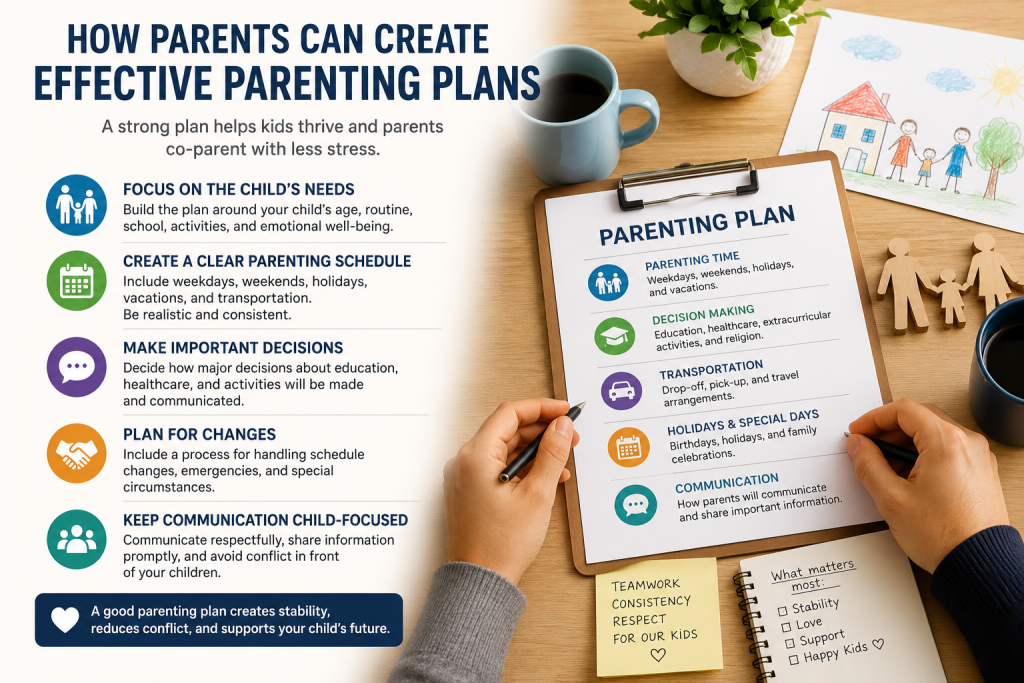
A parenting plan can help separated or divorced parents establish clear expectations about how they will share time and responsibilities for their children. A well-designed plan focuses on the child’s needs while reducing confusion about schedules, decision-making, holidays, and communication.
Start With the Child’s Needs
An effective parenting plan should be built around the child’s age, school schedule, activities, medical needs, and established routines. Parents should consider what arrangement provides consistency while allowing the child to maintain meaningful relationships with both parents when appropriate and safe.
Rather than focusing only on what each parent wants, the plan should address the practical needs of the child and make daily responsibilities manageable.
Create a Detailed Parenting Schedule
A parenting schedule should explain when the child will spend time with each parent. Parents may need to address regular weekdays, weekends, school breaks, holidays, birthdays, and vacations.
Transportation should also be considered. Clearly identifying who handles school drop-offs, pickups, and exchanges can prevent disagreements later.
The schedule should be realistic. A plan that looks balanced on paper may not work if parents have demanding work schedules, live far apart, or have other responsibilities that affect transportation and childcare.
Address Important Decisions
Parents should determine how major decisions involving the child will be handled. These may include education, health care, and other important aspects of the child’s well-being.
If parents share legal custody, they may need a clear process for communicating and reaching decisions. Establishing expectations in advance can make disagreements easier to manage.
Plan for Changes and Special Circumstances
Children’s needs and family circumstances can change over time. Parents can include a process for requesting schedule changes, handling unexpected events, and addressing missed parenting time.
Special arrangements may also be necessary for medical appointments, extracurricular activities, school events, or other important commitments.
Keep Communication Child-Focused
Effective communication is an important part of successful co-parenting. Parents should keep discussions focused on the child and maintain respectful communication about schedules, school, health, and other responsibilities.
A strong parenting plan does more than divide parenting time. It creates a practical framework that helps parents understand their responsibilities and gives children greater consistency during a major family transition. By focusing on the child’s best interests and anticipating everyday issues, parents can create a plan that is clearer, more workable, and easier to follow.
This post was written by a professional at the Law & Mediation Offices of Dan DeSario & Associates, a full-service law firm in Southern California specializing in family law, high-conflict divorce, child custody & visitation, domestic violence / restraining order defense, guardianships, private mediation, trials/litigation, and minor’s counsel appointments. As one of the leading law firms near you, we serve clients throughout Southern California, including Los Angeles County, Beverly Hills, West Los Angeles, San Fernando Valley (Van Nuys, Chatsworth), Ventura County, Long Beach, Redondo Beach, Manhattan Beach, Marina del Rey, Santa Barbara (existing cases), and San Diego (existing cases). If you are looking for a family law attorney in Beverly Hills, our experienced team provides expert guidance and reliable solutions, making us a trusted choice for family law and mediation services focused on quality, value, and performance.